Free Shipping & Free Return


Free Shipping & Free Return
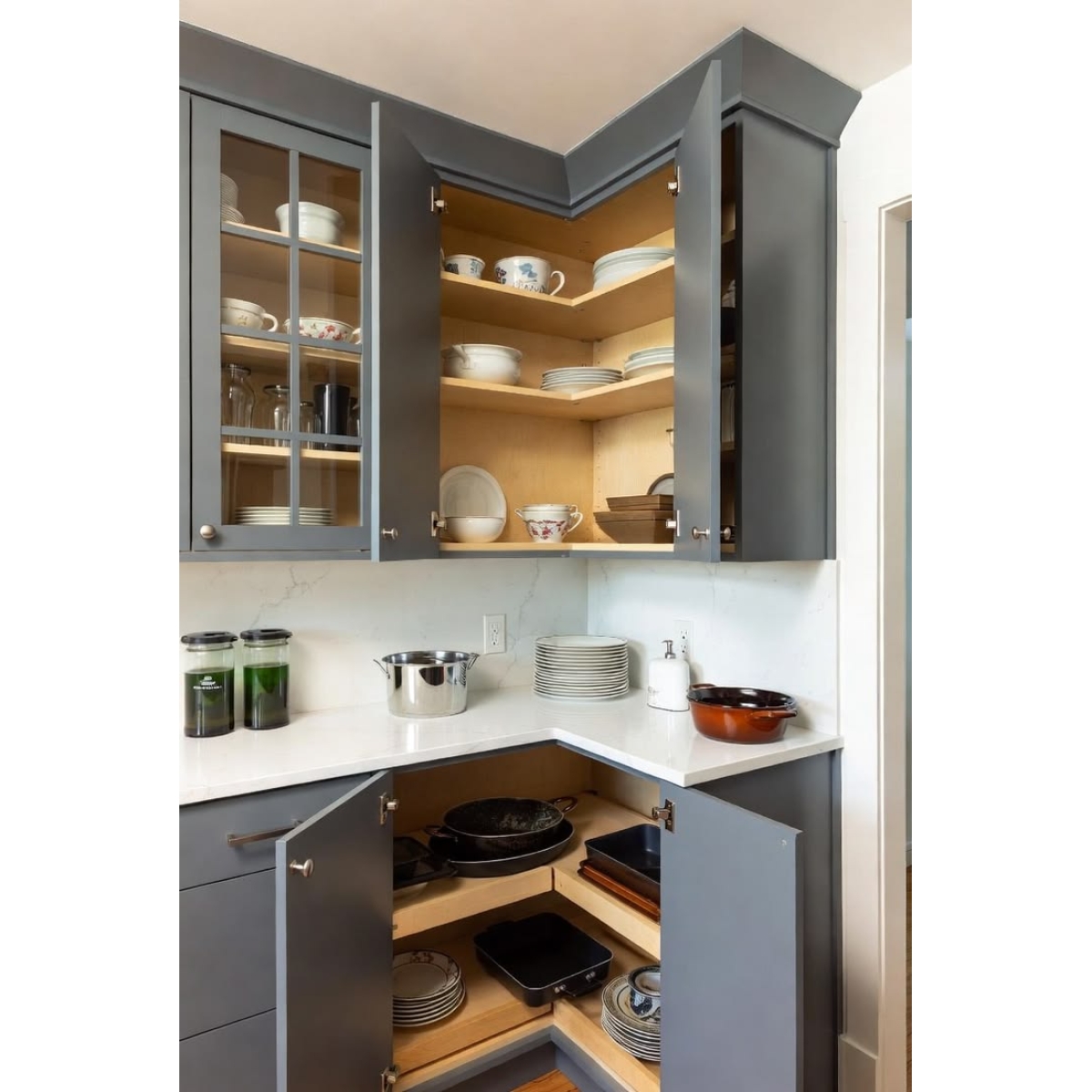
1000mm x 1000mm corner cabinet
SKU: 1000mm CBC
Optimising kitchen layouts often comes down to how efficiently you navigate the awkward, hard-to-reach angles where two walls meet. In Western Australia, homeowners and builders frequently turn to the 1000mm corner base cabinet as the ultimate spatial solution to convert dead zones into high-capacity storage areas. Whether you are planning a complete kitchen renovation in Subiaco or building a modern coastal home in Joondalup, choosing the right 1000mm Corner Base Cabinet Perth standard can make or break your kitchen ergonomics. This comprehensive guide explores everything from engineering clearances and innovative pull-out hardware to local material selection designed to withstand the unique Western Australian climate.
To appreciate the utility of a 1000mm corner cabinet, it is essential to understand its structural geometry. In kitchen design, a corner base cabinet typically occupies one of two configurations: an L-shaped corner unit or a blind corner unit. The 1000mm dimension usually refers to a blind corner configuration, which is engineered to run along one wall while partially tucking behind the perpendicular run of cabinetry.
In a standard blind Corner Base Cabinet setup, the physical carcass measures 1000mm in width. However, the footprint it occupies on your floor plan is different. Because it must interface with a adjacent 600mm-deep cabinet line, the actual space allocated on the wall is usually 1050mm to 1100mm. This extra 50mm to 100mm space is critical; it creates a "void" or "blind space" behind the adjacent cabinet, ensuring that doors and drawer fronts have enough clearance to open without colliding with handles or appliances.
The standard dimensions of a quality 1000mm corner base unit include:
When planning a kitchen in Western Australia, spatial constraints are a common hurdle. While larger custom homes in suburbs like Dalkeith or Peppermint Grove might have the luxury of vast sculleries, standard residential designs in inner-city Perth or suburban developments require smart footprint management. The 1000mm unit strike a perfect balance between storage volume and accessibility.
If you drop down to an 800mm or 900mm blind corner cabinet, the opening door size shrinks significantly. This makes reaching into the deep recess of the cabinet highly impractical, rendering the rear space virtually useless. Conversely, extending past 1000mm to a 1100mm or 1200mm cabinet can swallow up too much straight wall space, leaving less room for highly desirable drawer banks, dishwashers, or bin pull-outs. The 1000mm model is the mathematical "sweet spot" that maximizes internal storage volume while retaining a door wide enough to install modern pull-out wireware or shelving systems.
Choosing between a blind corner and an L-shaped corner base cabinet depends heavily on your kitchen's workflow, traffic flow, and aesthetic goals. Both options have distinct physical characteristics and clearance requirements.
This design utilizes a single straight door next to a blank "blind" panel. The adjacent line of cabinets abuts this blind panel at a 90-degree angle. The primary advantage of this layout is its clean, streamlined appearance. From the front, it looks like a standard single-door cabinet. The challenge, however, is accessing the deep space hidden behind the blind panel. Without specialized internal hardware, items stored at the far back are often forgotten or difficult to retrieve, requiring you to bend down and reach into a dark void.
Also known as a bi-fold corner cabinet, this style features a cut-out corner with a bi-fold door that opens up to reveal the entire interior at once. While access is generally easier without expensive hardware, the bi-fold door mechanism can be prone to sagging over time if high-quality hinges are not used. Additionally, this layout requires a footprint of at least 900mm x 900mm on both walls, which can disrupt the symmetry of your cabinet lines and limit your options for adjacent appliances.
An empty 1000mm corner cabinet is essentially a dark cave. To make this space truly functional, integrating high-quality internal hardware is highly recommended. Modern engineering has yielded several ingenious mechanisms that bring the contents of your cabinet out to you, saving your back and knees from strain.
Named after the famous racetrack due to its sleek, curving shelves, the LeMans system is widely regarded as the gold standard for blind corner cabinet storage. This mechanism features two independent, peanut-shaped trays that glide entirely out of the cabinet carcass. Because the trays extend fully, you have 100% visibility and access to your pots, pans, and dry goods. High-end LeMans systems, such as those manufactured by Kesseböhmer, feature soft-close dampening and can support up to 25kg per shelf, making them incredibly robust.
The Magic Corner is a mechanical marvel of kitchen engineering. When you open the cabinet door, the front baskets pull out and pivot to the side, simultaneously drawing the rear baskets forward into the front opening. This maximizes the rectangular volume of the 1000mm cabinet. While highly efficient, Magic Corners require precise installation and are slightly more restrictive in terms of height clearance between shelves compared to the LeMans system.
For L-shaped corner cabinets, a revolving Lazy Susan (either a 270-degree three-quarter circle or a full 360-degree circle) is a reliable, budget-friendly classic. Made of heavy-duty plastic, wire, or timber-wrapped melamine, these trays spin on a central chrome pole. While they do not bring the items completely outside the cabinet footprint like a LeMans, they rotate the items directly to the front for easy selection.
Designed specifically for blind corners, these semi-circular shelves rotate and slide forward out of the cabinet door opening. It is a simpler, highly cost-effective alternative to the LeMans II, offering a great balance of improved accessibility and budget management.
Perth's climate is characterized by hot, dry summers and cool, wet winters, coupled with high coastal humidity in suburbs stretching from Fremantle up to Mindarie. These environmental factors place unique demands on cabinetry materials. Selecting substandard timber or board products can lead to swelling, warping, and premature structural failure.
For cabinet carcasses (the internal box), Highly Moisture Resistant (HMR) particleboard is the standard recommendation for Australian kitchens. HMR board is formulated with special moisture-resistant resins that prevent the wood fibres from expanding when exposed to humidity or minor plumbing leaks under the sink. Ensure your cabinet supplier uses HMR board that meets Australian Standards (AS/NZS 1859.2) to guarantee long-term structural integrity.
For door fronts and visible end panels, MDF is the preferred substrate, especially when a painted or thermoformed finish is desired. MDF has a dense, uniform structure that resists warping much better than solid wood when subjected to Perth's dry heat. It provides an incredibly smooth surface for premium finishes like 2PAC polyurethane paint.
For high-end architectural builds, marine-grade or structural birch plywood is occasionally used for carcasses and open shelving. Plywood offers exceptional strength, screw-holding capacity, and a beautiful natural edge profile. While more expensive than HMR board, it provides unmatched durability and water resistance.
The longevity of a corner cabinet relies heavily on the quality of its edge banding. The edges of HMR boards must be sealed with a high-quality 1mm or 2mm ABS (Acrylonitrile Butadiene Styrene) edge band using polyurethane (PUR) adhesive. PUR glue is highly resistant to heat and water, ensuring that moisture cannot penetrate the core of the board—a crucial consideration in high-steam kitchen environments.
The visual design of your 1000mm corner cabinet should seamlessly integrate with the overall aesthetic of your kitchen. Perth home designs often emphasize bright, airy spaces that connect indoor living with outdoor entertaining areas. Here are the most popular finishes and styles used today:
This premium finish involves spraying a liquid acrylic polyurethane paint over MDF doors, which is then cured to form a hard, impervious shell. 2PAC is highly customizable, allowing you to select any colour from major paint brands and choose your desired sheen level—from ultra-matte to high-gloss. Because the paint wraps around the edges of the door, there are no visible seams, offering superior protection against moisture ingress.
Thermofoil doors are created by vacuum-pressing a vinyl foil over routed MDF profiles. This finish is highly durable, easy to clean, and resistant to chipping. It is an excellent, cost-effective option for busy family kitchens, offering realistic woodgrain textures and solid colours.
Modern low-pressure melamine (LPM) and high-pressure laminates (HPL) have advanced significantly. Brands like Laminex and Polytec offer stunning decorative boards that mimic natural timber, concrete, and industrial metals. These materials are incredibly scratch-resistant and UV-stable, meaning they will not fade when exposed to the harsh Western Australian sun streaming through large kitchen windows.
For a coastal Hamptons look—highly popular in Perth's beachside suburbs—choose shaker-style profiled doors in soft whites, greys, or navy blues, paired with elegant shell handles or knobs. For a contemporary, minimalist look, opt for flat-panel (slab) doors with a handleless "Gola" profile or push-to-open mechanisms to maintain clean, uninterrupted lines across your corner junction.
Installing a 1000mm corner base cabinet requires precision. Because the corner unit dictates the alignment of all subsequent cabinets along both walls, any error made here will telegraph down the entire run, resulting in crooked benchtops, misaligned doors, and uneven gaps. Follow this professional installation workflow to ensure a perfect result.
Before bringing any cabinets into the space, check the squareness of your walls and the level of your floor. In many older Perth homes, particularly those constructed with double-brick walls in suburbs like Subiaco or Fremantle, walls are rarely perfectly 90 degrees, and floors can slope. Use a long spirit level or a rotary laser level to find the highest point of the floor and mark a level reference line on the walls where the top of the cabinet carcasses will sit.
If your corner walls measure greater or less than 90 degrees, you will need to adjust the placement of the corner cabinet. Do not force the cabinet tight into an out-of-square corner, as this will throw off the entire run of cabinetry. Instead, align the cabinet perfectly square with your layout lines and scribe any gaps against the wall using a filler strip. A filler or "scribing template" can be trimmed to match the contours of an uneven brick or plaster wall, ensuring a seamless visual finish while keeping the cabinet box square.
Place the 1000mm corner cabinet into position. Adjust the heavy-duty plastic legs until the top of the carcass aligns perfectly with your level reference line on the wall. Check the level in three directions: left-to-right, front-to-back, and diagonally. Lock the legs in place once level is achieved.
Once leveled, secure the cabinet to the wall. For timber stud walls, locate the studs using a stud finder and screw through the cabinet's solid rear hanging rail using 65mm wood screws. For solid double-brick walls, drill through the rail into the masonry, insert appropriate wall plugs (such as rawlplugs), and secure with heavy-duty masonry screws. Ensure the cabinet is pulled tight to the wall without distorting the carcass frame.
Before clamping and screwing adjacent cabinets to the corner unit, install the corner filler panel (also known as the corner post). This panel must be wide enough to allow the doors and drawer fronts of both intersecting cabinet lines to open past 90 degrees without their handles colliding. Once the filler is secured, slide the next cabinet in the run into place, clamp it to the corner cabinet using face-frame clamps, check for flush alignment, and join them together using cabinet-connecting screws.
The moving parts of your corner cabinet endure constant daily use. Choosing high-quality functional hardware is vital to ensure your doors hang straight and glide smoothly for decades. Three European brands dominate the high-end Australian cabinetry market:
Blum is synonymous with premium cabinet hardware. Their Clip Top Blumotion hinges are renowned for their integrated soft-close mechanism, which can be deactivated if a lighter closing action is preferred. For corner cabinets, Blum offers specialized wide-angle hinges (such as 155-degree or 170-degree zero-protrusion hinges) that swing the door completely clear of the cabinet opening, allowing internal pull-out storage units to slide out smoothly without scraping the door back.
Hettich manufactures outstanding slide systems and hinges. Their Sensys hinge range features a highly responsive integrated silent system that performs exceptionally well in damp kitchen environments. Hettich also produces robust drawer runner systems, like the Actro 5D, which are perfect if you choose to install custom internal corner drawer systems rather than wireware.
Hafele is an industry powerhouse offering a vast array of clever storage solutions. They are the exclusive distributors of the LeMans II and Magic Corner systems in many regions. Hafele's hardware is designed for heavy-duty cycle testing, making it a favorite among commercial shopfitters and premium residential cabinet makers in WA.
When budgeting for your Perth kitchen project, you will face the choice between custom-built cabinets and flat-pack (ready-to-assemble) options. Understanding the cost-to-value ratio of each path is essential.
Flat-pack units are highly cost-effective and readily available from major hardware retailers. They are great for straightforward DIY projects where budget is the primary constraint. However, flat-packs come in highly rigid, standardized sizes. If your walls are severely out of square, adjusting a flat-pack corner unit can be highly frustrating and often requires custom modifications on-site, which can negate the initial cost savings. Furthermore, standard flat-pack hardware may lack the durability and smooth operation of premium European brands.
A custom-built 1000mm corner cabinet is manufactured to your exact spatial requirements. If your walls require a 1015mm cabinet to fit a specific alcove, a custom cabinet maker can build it down to the millimetre. Custom cabinetry utilizes superior materials, such as thicker HMR backing boards (16mm instead of the 3mm or 9mm backing found in cheap flat-packs) and comes fully assembled and glued for maximum rigidity. While the upfront cost is higher, the long-term value in terms of seamless installation, durability, and increased property resale value makes it a highly worthwhile investment.
Modern interior design places a heavy emphasis on universal design—creating spaces that are accessible and usable for people of all ages and physical abilities. Traditional deep corner cabinets are the antithesis of universal design, requiring physical strain to access.
By investing in a 1000mm base cabinet equipped with a high-quality pull-out system, you eliminate the physical challenges of deep cabinet storage. Items are brought out into the light, within easy reach of someone standing or seated in a wheelchair. This makes your kitchen far safer, reducing the risk of items falling out of dark overhead corners or users straining their backs while lifting heavy cast-iron pots from deep, awkward floor-level recesses.
Even with a well-configured door and internal shelving, the interior of a 1000mm base cabinet can still be cast in shadow by the benchtop overhang. Integrating smart cabinet lighting is an effective way to elevate the luxury feel and functionality of your kitchen.
Consider installing low-voltage LED strip lighting along the top rail inside the cabinet carcass, connected to a magnetic proximity sensor on the cabinet door. When the door is opened, the LED strip automatically illuminates the entire interior, making it easy to read labels on spices, canned goods, or small appliances. Opt for warm white light (3000K) to create a welcoming, high-end feel, or cool white (4000K) for crisp task-oriented visibility.
To ensure your 1000mm corner cabinet operates flawlessly for twenty years or more, implement a simple maintenance routine:
Designing, manufacturing, and installing a high-quality kitchen corner cabinet requires expert craftsmanship and local industry knowledge. At Elite Cabinetry, we specialize in creating premium, custom cabinet solutions tailored to the unique lifestyle and architectural styles of Western Australia.
Our team utilizes only the highest grade HMR boards, premium European hardware, and state-of-the-art manufacturing processes to deliver cabinetry that is beautiful, highly functional, and built to last. From initial spatial planning and hardware selection to precision installation, we work closely with you to transform your kitchen into a masterclass of modern ergonomics.
Ready to transform your kitchen storage and design the perfect corner cabinet layout? Contact our friendly, professional team today to book a design consultation.
Elite Cabinetry
Address: 7 Castlemore Mews, Ballajura WA 6066, Australia
Hotline: 0061416988655
Phone: 0061416988655
Email: sales@elitecabinetry.com.au
Website: https://elitecabinetry.com.au/
